Showing posts with label Apologetics. Show all posts

Friday, July 7, 2017

On the Unity of the Church


by Rev. P. Rafferty, 1849

Note: Scripture references are based on the Latin Vulgate. English translations of the Latin Vulgate include the Douay-Rheims Bible and the Knox Version.

That the true church of Christ is always one, and can be but one in her faith and communion, appears from many texts of Scripture. Song of Solomon vi.9,10. “My dove, my undefiled is but one – fair as the moon, clear as the sun, terrible as an army with banners.” St. John x.16. “Other sheep I have, which are not of this fold, (viz. the Gentiles, who were then divided from the Jews,) them also I must bring, and they shall hear my voice, and there shall be one fold and one shepherd.” Ephesians iv.4,5. “There is one body, and one spirit, as you are called in one hope of your calling; one Lord, one faith, one baptism.” Romans xii.5. “We being many are one body in Christ, and every one members one of another.” St. John xvii.20,21. “Neither pray I for these alone (the apostles), but for them also that shall believe in me through the word, that they all may be one.” Nor could the church or kingdom of Christ, long subsist without this unity. “For every kingdom divided against itself is brought to desolation, and every city or house divided against itself shall not stand." St. Matthew xii. 25

Hence, where this unity is wanting, it is a certain mark that the true church of Christ is not there. And consequently that scheme of Protestants must fall to the ground, which maintains, that the church of Christ is not in one only communion; but is a collection of many disagreeing sects divided from each other in faith and communion: for here is no unity, and consequently, this cannot be the true system of the church of Christ, which, according to the Scripture and creed, is ever one.

For the same reason the reformation in general, or the reformed church taken in that latitude as to comprise the whole collection of Protestant sects, cannot be the true church of Christ; because it wants this mark or property of unity. Luther to his dying day looked upon the Zuinglians, and all that denied the real presence, as heretics and aliens from the church of God. (See his lesser confession, and his theses against the Lovanists, t.7, fol 503, 2.) His followers have inherited the same notions to this day, with regard to Calvinists. The Church of England Protestants look upon the dissenters as schismatics; and the dissenters avoid the communion of the established church, as not sufficiently purged from superstition and idolatry. Can this be the one fold of Christ? Or can his sheep run so many opposite ways?

Nay, so far are Protestants in general from this unity, which is one of the marks of the church of Christ, that there are scarce the least footsteps of it to be found in any one sect or denomination of them: for, pick out which you please of these sects, and examine into their whole system of faith, and you will find no agreement either with one another, or with the first authors of their sect. In so much that, if you go to consult any two ministers, experience teaches they do not both agree throughout in their notions of religion; and neither the one, nor the other with the first reformers, whose systems they have all forsaken; nor are their disagreements in matters of small moment, but of the highest importance: some in every sect are Arians with relation to the Trinity; many are Latitudinarians; great also are their differences with relation to “Church government, church authority, the necessity and nature of the sacraments, the presence of the body and blood of Christ in the Lord's Supper; free will; predestination; and the state of souls departed; the necessity of faith in Christ for salvation; lay baptism, &c.” The last of which controversies, as it is decided by most of the divines of the English Protestant church, unchristians, and consequently unchurches, not only all Dissenters, but also all the Lutherans and Calvinists, who having no bishops, consequently, in the system of these divines, have no other ministers than mere laymen.

Nor is there any way left amongst Protestants, for their church to put an end, by her authority, to these contests of her children; since they can never be persuaded that they are obliged to pay any greater deference to her decisions, than their forefathers, the first reformers, were to the decisions of the whole church then in being.
Chapel of the Benedictines of the
Abbey of Our Lady of Montserrat
Mendiola, Manila
(c) Vincent Domingo

But how is it then with the Catholic Church, with regard to this unity, which is one of the properties of the true church of Christ? Why she is one, by the union of all her children in one faith, and one uniform profession of faith, unalterable and inviolable, viz., that published by Pius IV, in maintaining every article whereof, all Catholics throughout the world unanimously agree. She is one by the union of all her children in one communion. And for the maintaining this one faith and communion, she has one visible head, and is guided by one church authority, to which all her children are bound to assent; and by which all disturbers of unity, and innovators of faith, are cut off from her unity.

So that the followers of the Catholic Church, in point of unity, have clearly many advantages above Protestants. 1st, because all Catholics agree in one confession or profession of faith: Protestant churches could never yet agree in any one such confession. 2dly, because all Catholics, however spread throughout the world, are in one and the same communion: Protestants are divided into many separate sects, which refuse to communicate one with another. 3dly, because all Catholics have one visible head of the church, one apostolic see, the centre of unity, to which all are subject, and in which all are united. Protestants, as the learned Sir Edward Sands long ago complained, (Relations of the Religions of the West,) “are as severed, or other scattered troops, each drawing different ways, without any means to pacify their quarrels; no patriarch, one or more, to have a common superintendence or care of their churches, for correspondence and unity: no ordinary way to assemble a general council of their part, &c.” 4thly, because Catholics embrace a rule of faith which must maintain them in unity, viz., the Word of God, as interpreted to them by the Church, to whose authority they all hold themselves bound to submit: so that if any dispute arise, when once the Church has interposed her judgment, whosoever presumes to dissent, is no longer looked upon by Catholics as one of their society, but as a heretic and a schismatic. Protestants, on the other side, maintain a rule of faith, which, human weakness considered, is utterly inconsistent with unity in religion, and cannot but be a perpetual source of endless divisions. Such is the Scripture, or Word of God, as interpreted by each one's private judgment. For when Protestants appeal to Scripture, as the only rule of faith, they do not mean the Scripture, as interpreted to them by the church; for if they had gone by this rule, their reformation would have been stifled in the very cradle ; much less they mean the Scripture as interpreted by any particular minister or preacher; but as interpreted by every Christian of sound judgment, who has, according to the principles of the reformation, a right to interpret it for himself, and is no more obliged to follow the interpretation of Luther, for example, or of Calvin, or of any other divine, synod, or church, if their interpretation seem not to him agreeable to the true meaning of God's word, than they were obliged to follow the interpretation of the Catholic church. Whosoever disallows of this truly Protestant rule of faith, must condemn the reformation begun by a single man, in opposition to the whole world: and whosoever maintains this rule must consequently allow all those who steer by it to be true Protestants, however disagreeing their principles in religion may otherwise be, nay, though there were not two of them all that agreed in any one single article, except this, of taking the Bible alone, as interpreted by themselves, for their rule of faith. Which indeed is the source of all their disagreements; so that there can be no hopes of their ever being united in one body, as long as they follow this rule of faith. So much have Catholics the advantage over Protestants in this point of unity.

As to disputes amongst Catholic divines, which our adversaries sometimes allege, in order to disprove the unity of the church: it may suffice for an answer to this objection, to remark two things. 1st, that these differences are never in matters decided by the church; and consequently are only in matters of opinion, never in matters of faith. 2dly, that these school questions make no breach of communion, and consequently divide not the unity of the church. Can Protestants say as much of the differences that are amongst them, which have no communion one with another?

Thursday, June 29, 2017

On Communion with the See of Peter, the Center of Unity

by Rev. P. Rafferty, 1849

Note: Scripture references are based on the Latin Vulgate. English translations of the Latin Vulgate include the Douay-Rheims Bible and the Knox Version.

One great means for maintaining the Church in unity, was the institution of one chief pastor to have a superiority and superintendence over the rest; that so all being subjected to one, might be united in one centre; upon this account, as the holy fathers have observed, our Lord made choice of St. Peter, to make him the chief and head among the apostles, “that a head being constituted,” says St. Jerome, (lib. 1, contra Jovin.) “occasion of schism might be taken away.” Ut capita constituta, schismatis tolleretur occasio. See also St. Cyprian, lib. de Unitate Ecclesiee, St. Optatus, lib. 2, contra Parmenianum, &c.

In effect, nothing can be more evident from Scripture, than that our Lord did make St. Peter the chief pastor of the church; giving him a name that implied no less than a rock or foundation stone, St. John i.42; St. Matthew xvi.18; promising him “the keys of the king dom of heaven, with the chief power of binding and loosing,” v. 19, praying for him that “his faith might not fail,” and giving him the commission to confirm his brethren, viz., the rest of the apostles, St. Luke xxii. 31, 32. In fine, three times committing to his care all his lambs and all his sheep, without exception, that is, his whole flock, St. John xxi. 15, &c. after having asked him, “Dost thou love me more than these?”
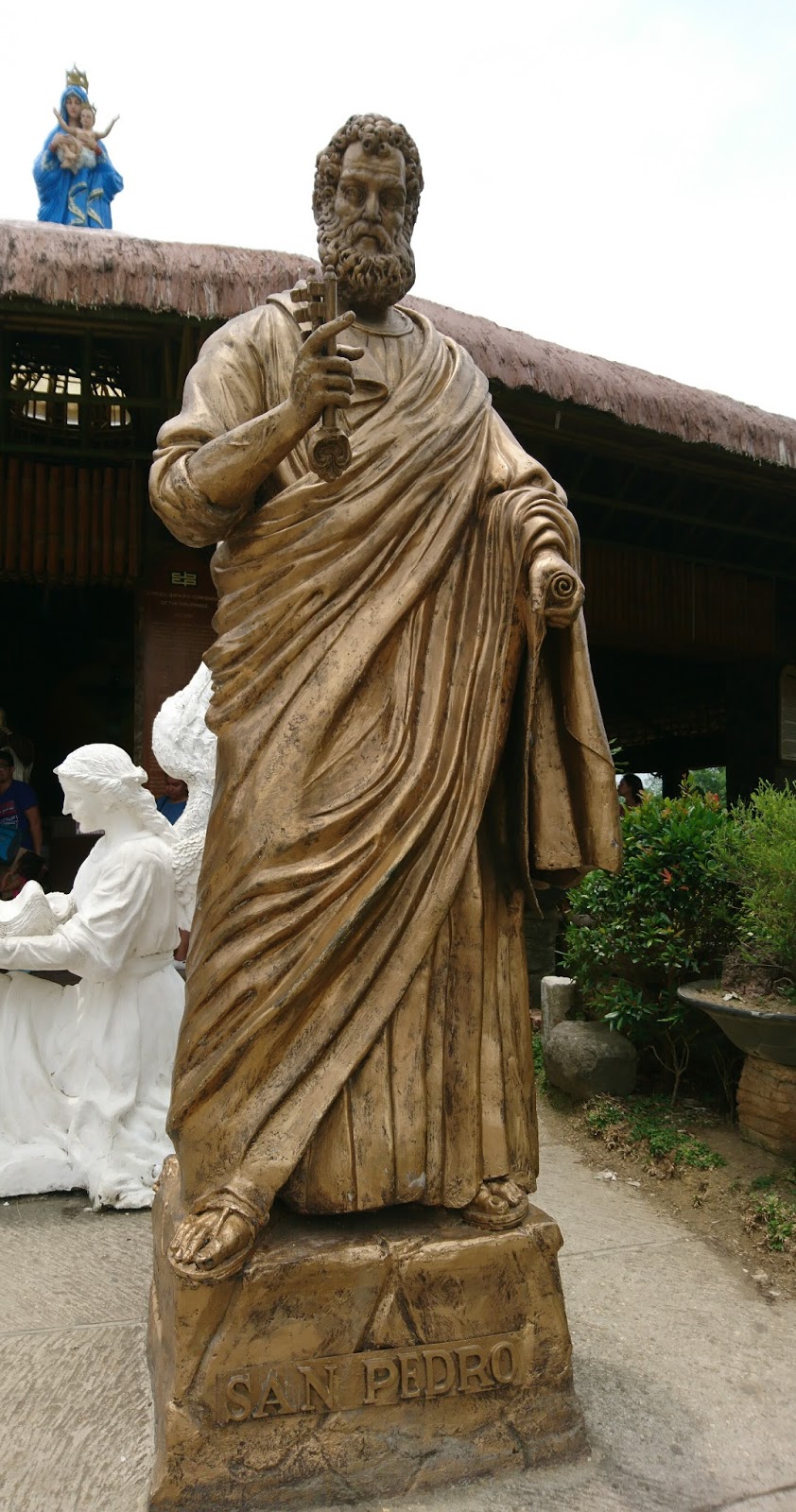
Statue of St. Peter at the National Shrine of St. Pio of Pietrelcina,
Sto. Tomas, Batangas
(c) Vincent Domingo

And as our Lord was pleased to constitute one head among the apostles, in the person of St. Peter, as the best preservative against schism, and the best form of church government; so it is not in the least to be questioned, but that he designed the same form of government to continue in his church till the end of the world; and that St. Peter's prerogative should descend to his successors: for how can any Christian imagine Christ should appoint a head for the government of his church, and maintaining of unity during the apostles' time, and design another kind of government for succeeding ages, when there was like to be so much more need of a head? Consequently it must be granted that St. Peter’s supremacy was by divine institution to descend to his successors: and these successors are no others than the bishop of Rome. For neither has the church of God ever acknowledged any others, nor have any others claimed the title of St. Peter's successors; and in that quality exercised jurisdiction in all parts of the church from the earliest times of Christianity.

Hence the holy fathers have frequently appealed to the Roman succession and tradition, as the touchstone of orthodox faith; have looked upon the Roman chair as the centre of Catholic unity, and ever alleged the communion with the apostolic see as a mark of the true church, and an invincible argument against all sectaries. Witness the following testimonies:

1. St. Irenaeus, bishop of Lyons, and martyr in the second century, who in his younger days had been a hearer of St. Polycarp, disciple of the apostles, in his third book against all heresies, chap. 3, thus delivers himself. “Because it would be an endless business, in a work like this, to trace up the succession of all the churches; we allege the tradition which that greatest and most ancient church, well known to all, founded and established at Rome by the two most glorious apostles Peter and Paul, has received from the apostles, and the faith which has been there delivered, coming down to us by succession of bishops; and so we confound all those who, either through a wicked self-complacence or vainglory, or else through blindness and error of judgment, make unlawful assemblies (prseterquam oportet colligunt). For to this church, by reason of its more powerful principality, (propter potentiorem, or as others read it, potiorem principalitatem,) it is necessary that every church has recourse, (necesse est omnem convenire ecclesiam,) that is, the faithful on all sides. In which [church] the apostolical tradition has always been preserved by those that are in every place.”

After this he sets down the succession of the bishops of Rome thus. “The apostles having founded and established the church, entrusted the episcopal ministry to Linus, who is mentioned by St. Paul in his epistle to Timothy. To him succeeded Anacletus. After him Clement, the third from the apostles, inherited the bishopric, who also had seen the blessed apostles, and conversed with them. To this Clement succeeded Evaristus; Alexander; to whom succeeded Xystus, sixth from the apostles. After him came Telesphorus, who also suffered a glorious martyrdom. Then Hyginus; after him Pius. To whom succeeded Anicetus, who had for his successor Soter. And now Eleutherius in the twelfth place from the apostles, inherits the bishopric. By this order and succession the tradition of the apostles in the church, and the preaching of the truth has come down to us. And this is a full evidence, [plenissima ostentio, a most clear demonstration] that it is one and the same life-giving faith, which from the apostles’ days has been preserved in the church till now.” So far St. Irenaeus.

2. Tertullian, writer of the same age, makes use of the same argument against all heretics, (Lib. prsescript. chap. 36.) “Come on now,” says he, “you who have a mind to exercise a laudable curiosity in the concern of your salvation. Run through the apostolic churches, in which to this day is maintained a succession in the very chairs of the apostles, (apud quas ipsae adhuc cathedrae apostolorum suis praesidentur locis.) If you are near Italy, you have Rome, from whence we also (Africans) have authority at hand. A church happy in her condition, to which the apostles bequeathed their whole doc trine with their blood: here Peter was honoured with the resemblance of the Lord's passion: here Paul was crowned with the martyrdom of the Baptist; here John the apostle, after coming out without hurt from the burning oil, received sentence of banishment in an island. Let us see what this church has learnt, what she has taught, &c.” Where he goes on, confuting all the prevailing heresies of those days by the doctrine of the church of Rome.

3. St. Cyprian, bishop of Carthage, and martyr in the third century, in 55th epistle to Pope Cornelius, complaining of certain African schismatics, delivers himself in this manner. “Moreover they dare to cross the seas, and carry letters from their schismatical and profane faction to the chair of Peter and the principal church from which the priestly unity has its origin, (Ecclesiam, principalem, unde unitas sacerdotalis exorta est,) not considering that the Romans are they whose faith was praised by the apostles, (Romans i) to whom false faith (perfidia) has no access.”

4. St. Optatus, bishop of Milevis in Numidia, and one of the principal champions of the church of God against the Donatists, in his sacred book against Parmenianus the Donatist, bishop of Carthage, thus addresses himself to his adversary. “You cannot pretend to be ignorant that Peter held fast the bishop’s chair in the city of Rome, in which Peter, head of all the apostles, sat – in which one chair, unity might be maintained by all; lest the rest of the apostles should each one claim his own separate chair. So that he is now a schismatic and offender, who against this single chair erects any other. In this one chair, which is the first of the properties of the church, Peter first sat; to him succeeded Linus, to him Clement, &c.; to Liberius succeeded Damasus; to Damasus, Siricius, the present bishop; with whom we (the Catholics of Africa) and all the world communicate. Give you now an account of the origin of your chair, you who claim to yourselves the holy catholic church.” So far St. Optatus.

5. St. Jerome, writing to Pope Damasus, Epist. 57, Anno 376. “Because the east, divided by intestine jars, rends in pieces the seamless coat of Christ, - so that in the midst of these broken cisterns, that hold no water, it is hard to find out the sealed fountain and enclosed garden: therefore have I thought it proper to consult the chair of Peter, and that faith which was praised by the mouth of the apostle, seeking from thence food for my soul, where I first put on the garment of Christ. I am joined in communion with your holiness, that is, with the chair of Peter: upon that rock I know the church is built: whoever eats the Lamb out of this house is profane; whosoever is not in the ark shall perish in the deluge. I know not Vitalis, I reject Meletius, I am ignorant of Paulinus, (he speaks of the three that at that time contended for the patriarchal see of Antioch). Whosoever gathers not with thee, scatters; that is, he who is not of Christ, belongs to Antichrist.”

And in his 58th epistle to the same Pope. “On one side of me, the Arian fury rages, supported by the secular power; on the other side, the church (of Antioch) divided in three parts, seeks to draw me to her. In the mean time I cry out, whosoever is joined with the apostolical see, he is my man.” So far St. Jerome.

6. St. Augustin, in his psalm against the Donatists, thus speaks to these schismatics. “Come, brethren, if you have a mind to be engrafted in the vine, it is a pity to see you lie lopped off in this manner from the stock. Reckon up the prelates in the very see of Peter; and in that order of fathers, see which has succeeded which. This is the rock over which the proud gates of hell prevail not.” He makes use of the same argument of the succession of bishops of Rome from St. Peter, against the Donatists, in his 165th epistle to Generosus, and against the Manicheans and all other heretics, in his book of the Advantage of believing, c. 17.

And in his book against the epistle of Manicheus, which was called the Foundation, chap. 4, he gives it amongst other arguments or motives of credibility, which made him prefer the Catholic communion to all others; where he writes as follows: “Not to speak of that most sincere wisdom, which you (Manicheans) do not believe to be in the Catholic church, there are many other things which most justly hold me in her communion. 1. The agreement of people and nations. 2. Her authority begun by miracles, nourished by hope, increased by charity, confirmed by antiquity. 3. A succession of priests descending from Peter the Apostle, to whom Christ after his resurrection, committed his flock to the present bishop. Lastly, the very name of Catholic, of which this church alone has, not without reason, in such manner kept the possession, that though all heretics desire to be called Catholics, if a stranger were to ask them where the Catholics go to church, none of them all has the face to point out his own church or meeting-house.” So far St. Augustin. And let the world judge by this, what his sentiments would be of modern sectaries.

From all that has been said in this section, we gather the following arguments in favour of the ancient religion. 1. We alone communicate with the successors of Peter, to whom Christ committed his whole flock: therefore, we alone are the sheep of Christ. 2dly. The chair of Peter was, according to all antiquity, established by Christ to be the centre of unity to the whole Church: we alone are united to this centre of unity. 3dly. The Roman succession and tradition is ever urged by the fathers as an invincible argument against all sectaries: this succession and tradition is wholly on our side.


Thursday, June 22, 2017

The Nature of Heresy and Schism

by Rev. P. Rafferty, 1849

Note: Scripture references are based on the Latin Vulgate. English translations of the Latin Vulgate include the Douay-Rheims Bible and the Knox Version.


Heresy, according to the Catholics, is “an obstinate adhesion to any error contrary to divine revelation, duly proposed to our belief by the Church of God; that is, contrary to what God has taught, and the church holds to be a revealed and apostolical truth; or, a wilful separation from the doctrine of the Catholic church in matters of faith.” According to Protestants, “it is an obstinate defence of error against a necessary or fundamental article of Christian faith.” But the ancient church knew nothing of this distinction; and therefore condemned all heretics that dissented from doctrine, whether the articles in which they dissented were of the number of those, which these gentlemen called fundamental or not. And certainly “an obstinate defence of error against any article which God has taught,” must needs be a damnable sin; and what sin is it, if not heresy? and who shall be judge in these cases, what articles of Christian faith are necessary to be believed, if not the church of God, which proposes them to our belief?

Schism, according to Catholics “is a wilful separation from the unity and communion of the church, and the subordination due to the church governors.” According to Protestants, it is “a causeless separation of one part of the church from another.” But who shall be judge whether the separation be causeless, or not? Or can there be a just cause for a separation from the Catholic church, with which Christ has promised to abide for ever? (St. Matt. 28:19, 20)

Now the children of the primitive religion are very secure, that in adhering to their church guides, they are neither guilty of heresy nor schism. They cannot be guilty of heresy, because they hold nothing contrary to the definitions of the church, or to the word of God, as interpreted by the greatest authority upon earth, viz. that of the church of God. Much less can they be guilty of heresy, according to the Protestant notion of heresy, viz. of error in fundamentals; since our very adversaries are obliged to acknowledge, that our church does not err in fundamentals.

Besides, heresy, according to the scriptures, is a damnable crime, Galatians 5:20,21; Titus 3:10,11; 2 St. Peter 2:1,2; St. Jude 13. The malignity of which consists in wilfully refusing to believe that which God has taught, after it has been duly proposed to our belief, by such an authority, and upon such grounds, or motives of credibility, that it would be highly imprudent to doubt that God has taught it; in which case the refusing to believe, is highly injurious to God, by calling in question his truth. Now Catholics are very sure they are guilty of no such crime as this; because they refuse to believe no one revealed truth, which by sufficient authority and upon due grounds is proposed to their belief; and in all those things in which they believe differently from other Christians, they have on their side the greatest authority upon earth, and the strongest motives of all others to convince them that what they believe is the same as God has taught.

Moreover, the root of all heresy is pride and conceit of man's own judgment, which he prefers to all other authority; for an humble man can never be a heretic. Therefore the followers of the old religion, who walk in the humble way of submission to the church authority, and take up nothing of their own invention, or upon any presumption of their own judgment, follow their guides of divine appointment, can never be guilty of the sin of heresy. Again: — The chief points of the doctrine of the Catholic religion, which are accused by our adversaries as grievous and pernicious errors, were certainly held long before the pretended reformation, by the whole eastern as well as western church; and consequently the holding of them could be no heresy at that time, when they were held by the universal church, which (as Protestant divines allow) never falls into heresy. Now if the holding of these articles was not heresy then, I would gladly know what can make it heresy at present? Not the word of God, which was the same then as it is now. Nor any new declaration of the word of God, or definition of the church or council; because the most authentic, and most universal that has been since, has been on the side of the Catholic.

And as we are secure against heresy by following the old religion, so are we also against the guilt of schism. Because we never broke off from the communion of any more ancient or superior church, or withdrew our obedience from any church governors, keeping within the bounds of a due subordination to our superiors. Now as rebellion in the state, so schism in the church, can only be when a lesser, or at least an inferior part, separates from the greater or superior; which, I have said, was never our case, who never went out from any greater or superior church; but in all divisions of religion, that ever yet have been, we have always had at the time of the beginning of such division, both a majority of number, and a pre-eminence of dignity and authority with respect of number, and pre-eminence of dignity and authority with respect to those that have been divided from us. We are the great body of christians descending from the apostles, from which all other sects at their first beginning separated themselves; and whose authority they all acknowledged before the separation. Therefore we cannot possibly be schismatics.

If it be objected that the guilt of schism lies at our door, for giving cause to it, by insisting upon terms of communion which could not in conscience be complied with, and casting out of our communion all those that refused to concur with our innovations: we answer, first. That it has always been the method of all schismatics to charge the church with giving cause to the schism. 2dly, That the pretence of conscience against church authority is also the cloak, by which all heretics and schismatics have sought to cover their obstinacy and pride: and that it has alsombeen the way of all innovators to accuse the church of innovations. 3dly, That the church governors have been authorized by Christ to be judges in these cases, (St. Matt. 5:17) and to cast out of the communion of the church such as obstinately refuse to hear and obey them. 4thly, That even supposing the case of an unjust excommunication, the person excommunicated is not thereby authorized to set up altar against altar; nor does the excommunicator thereby forfeit all authority, or become a schismatic. 5thly, That the person excommunicated, is not a competent judge of the justice or injustice of the sentence of his superiors. 6thly, That in the case of modern sectaries, they did not stay till they were cast out of the church, but run out of it of their own accord, and enticed as many as they could to come out after them. In fine, that at the time when the division began, we only continued where we were, in the terms of communion which had been fixed long before; therefore they broke off from us, not we from them: as the ship breaks loose from the shore, not the shore from the ship; because the shore continues just where it was. From all which it is visible, that the schism is not on our side.

Besides, the professors of the Catholic religion wear none of the badges whereby scripture and antiquity will have us know and distinguish heretics and schismatics. Such as preaching without being sent, Jerem. 23:21; Rom. 10:15; Heb. 5:4. Not entering into the sheepfold by the door, but climbing up another way, St. John, 10:1. Going out of the established church, and the communion of the undoubted successors of the apostles, 1 St. John, 2:19. Separating themselves, St. Jude 19 causing divisions and offences contrary to the doctrine which the children of the church have learnt, Rom. 16:17. Preaching to them a new gospel, Gal. 1:8-9. Wolves in sheep's clothing, but easily known by their evil fruits, St. Matt. 7:15-16. Perpetually chopping and changing, and varying from their own rules, Tertullian (de Praescript. chap.xlii). Rising long after the church from which they separated themselves, Tertullan, ibid. chap.xxxi. Where he gives us this rule to distinguish heretics by, as a sentence that shall stand for the condemnation of all future heresies. “Id esse dominicum et verum, quod est prius traditum; id autem extraneum et falsum quod est posterius immissum.” That is of the Lord, and is true, which was of elder date; but that is foreign and false which came in later.

Now as it is evident that none of these marks of error and schism agree to the Catholic religion and its professors, so it is visible that they have all been found in every one of the modern sects: who all from their very first setting out, preached without any mission, either ordinary from the Church, or extraordinary from God; and consequently did not enter into the sheepfold by the door; they all went out and separated themselves from the ordinary succession of the Church; “caused divisions and offences, preached a new gospel;” fell out immediately amongst themselves; and have ever since been daily varying in their doctrine, and uncertain what they would be at: in fine, have all from the very beginning brought forth such fruits, as could never spring from a good tree.

But setting all this aside, it is easy to prove the guilt of schism upon them all, from this plain matter of fact. At the time of their first origin, when they separated themselves from the Roman Catholic church, they did not embrace the communion of any other church then in being; but stood all alone upon their own bottom, divided from all churches upon earth, which was confessedly Luther's case, about the year 1517. Therefore if at that time there any where was a true church of Christ upon earth, (as there always is, if the scripture and creed be true,) the first authors of all these sects originally separated themselves from the true church of Christ, wheresoever or whichsoever she was; because they separated themselves from all churches, pure or impure, which had any being upon earth before their time, and consequently they were all guilty of schism.

Neither is it much harder to prove the guilt of heresy upon them all. Because, from their very first setting out they all obstinately maintained sundry doctrines condemned by the universal Church, as heretical and contrary to divine revelation, many ages before. Now that which is once heresy, is always heresy; as that which is once truth, is always truth.

Nor is there indeed any rule by which the ancient or modern Arians, for example, can be proved to be heretics, but what will prove the same with regard to the sectaries of these days; both the one and the other were and are willing to be judged by the Scriptures as interpreted by themselves: both the one and the other have been condemned by the Scriptures as interpreted by the church. Therefore either both are heretics or neither.


Wednesday, June 7, 2017

How to Find the True Church of Christ

by Rev. P. Rafferty, 1849


The first rule is that of Tertullian (de Praescript, c. 22.), “Quod apud inultos unum invenitur, non est erratum, sed traditum. That which amongst many is found one, is no error, but handed down.” In other words, tradition, time out of mind. “And let any one dare,” says he, “affirm that they were in an error who begun this tradition.”

The second rule for finding out apostolical traditions, is given by St. Augustin, (L. 2, Bapt. c. 7 ; L. 4, c. 23, and L. 5, c. 23,) which is this: “Whatever is found to have been held by the universal church over the whole world, and not to have had its beginning from any ordinance of bishops or councils, but to have been prior to any such ordinance, that is to be esteemed a tradition of those by whom the church was first established, that is, of the apostles of Christ.” By this rule this great doctor of the church proves against the Donatists, that baptism given by heretics ought not to be reiterated, because of the ancient custom of the church, which received their baptism; and by this very same rule, Catholics, with the highest degree of evidence, and the utmost force, maintain the doctrines and practices of the church, which modern sects have protested against, to be indeed apostolical traditions, by reason of the long possession they have obtained throughout all Christendom. A possession have not acquired any ordinances of councils, but have had before any such ordinances, and which they quietly enjoyed, long before it was contradicted by any man, which was certainly the case of sacrifice of mass, of prayers for the dead, of the invocation of saints, &c. These are all certainly apostolical traditions. Now the apostles delivered nothing but true doctrines, to be handed down from age to age.

The third rule is that of St. Irenae, in his third book against heresies, chap. iv. And of Tertullian, in his book of prescriptions, chap. xxxii and xxxvii viz.: That to discern what traditions are apostolical, and what not, we must have recourse to the churches founded by the apostles, and learn from them what the apostles taught. For as by their testimony we know what scriptures are apostolical, and what not, so by their testimony we are to know what traditions are to be esteemed apostolical, which have been delivered as such by the churches founded by the apostles, amongst which the greatest and most ancient, according to Irenaeus in the same place, is that of Rome, founded by the two most glorious apostles, Peter and Paul; to which church, by reason of its more powerful principality, “all must have recourse, and in which the apostolical tradition has always been preserved by those that are in everyplace.”  “A happy church,” says Tertullian, chap, xxxvi., “its condition to which the apostles bequeathed their whole doctrine with their blood.” This rule is certainly well-grounded; because, as our Lord by himself, and by his holy Spirit, certainly taught his apostles all truth, so his apostles, by his commission, certainly delivered all that he taught to the churches which they founded. So that these are certainly the best qualified to be witnesses of what the apostles taught which are the things we call apostolical traditions. By the application of this rule to our modern controversies, the first religion must certainly gain her cause against all sects; because, notorious to all the world, that when the present differences in religion first began, all apostolical churches, with one accord, received, held, and maintained those doctrines and practices for apostolical traditions, which are now rejected and impugned by the pretenders to reformation.

Against these rules our adversaries object, that all the churches founded by the apostles, and in a word, all Christendom, quickly forsook or corrupted the doctrine of the apostles, and went astray into error, superstition, and idolatry; and therefore there was a necessity for their reformation, which, if we will believe them, was nothing else but bringing back again the primitive doctrines which had possession of the church before she was corrupted with popery.

This impious pretence, upon which the whole reformation is grounded, is demonstratively confuted by all those texts of scripture which assure us that the church founded by Christ should never be corrupted by damnable errors. It is also infinitely injurious to Christ, giving Satan so early a victory over his kingdom. Yet the reformers pretend that the whole church of God of the New Testament, “Laity and clergy, learned and unlearned, all ages, sects, and degrees of men, women and children of whole Christendom, were at once drowned in abominable idolatry, of all other vices the most detested by God and damnable to man, and that for the space of eight hundred years and more.” (Hom. of peril of idolatry, part iii)

But for the more fully confuting this groundless system, which pretends that the primitive Christians were Protestants, till their successors introduced popery; and to demonstrate the perpetual succession of the Catholic doctrine from the apostles, I shall borrow the words of a modern writer upon this subject, which seem to me to put the matter out of dispute. “If the faithful in the first centuries were Protestants, when and how did their posterity become papists.” (for papists they certainly were, when Luther undertook to reform the church's doctrine, anno 1517, and had been so for many hundred years.) In what year of our Lord did this popery first creep into the church? Who was the first author of it? In what place was it first broached? What opposition did it meet with at its first appearance from the zeal of the pastors of the church? What disturbances did it cause? What books were written on this occasion, what councils held? &c. Or was this the only change in religion, the only heresy, which crept into the world without author, without date, without disturbance, without resistance; so that the whole world, by a strange revolution, from Protestant became papist, though no one knows how, nor when?

“We can trace up protestancy to the very year in which it was first broached, viz. 1517, we can name the day when their first preacher laid the foundations of their religions, (by his first sermon at Wittenburg against indulgences,) at which time we could have said to them with truth, your profession had no being yesterday. We can tell the author, the place, the first and chief abettors of their doctrine; the disturbances it caused; the resistance which it met with; the books written on both sides, &c. We can do the same with regard to Arianism, and all other heresies or innovations in religion. Let them name the pope or bishop of Rome for these 1847 years that brought into the church a religion different from that in which his immediate predecessor both lived and died. Which, as they certainly cannot do, is a plain demonstration the faith of the church was never changed.

“I would here ask of these gentlemen, who would persuade us that Protestancy was the religion of the first ages, and that there was a time when the whole church was Protestant, whether these ancient Protestants, at the first appearance of popery, all unanimously agreed to embrace it; or whether a great part of them stuck out, and remained steady to their ancient faith? If a great part of them stuck out, and continued steady to the Protestant religion, what disputes did diversity of sentiments produce? What books were written for and against, as always happens on such occasions? If all at once were bewitched into an unanimous agreement in popery.”

I know our adversaries will say that popery, as they call it, was not all brought into the church at one time, but by degrees; that prayers for the dead were introduced in one century; invocation of saints in another, and so of the rest.

But this reply does not at all lessen the force of our argument; as may be easily made appear in the aforesaid instances of prayers for the dead, and invocation of saints. Prayers for the dead are laid aside in all the reformed churches, as vain and superstitious; though they cannot but acknowledge, that they were maintained and practised by the universal church. And Arius, as we learn from St. Epiphanius, Haer. 75, and St. Augustine, Her. 27, was in the fourth century ranked amongst the heretics, for presuming to say, that the prayers and alms of the living did the dead no good. Now, if there ever was a time when the primitive Christians were Protestants in this particular, so as to be convinced that prayers for the dead were vain and superstitious; if this, I say, was the notion of the Christians of the first and second century, how was it possible that their immediate successors in the third century, should so unanimously embrace this practice; should reckon it amongst their most ancient traditions? (Tertullian de corona militis, c. 3.) “And the first man that offered to oppose it in the following age, should upon that account be condemned as an heretic; especially since our adversaries must acknowledge, that in the third and fourth century the church was well stocked with prelates, both learned and zealous against all novelties, that would never have sat still and tamely suffered the faith to be corrupted by any man.”

In like manner as to the invocation of saints, which many Protestants accuse of downright idolatry; it is confessed by their best divines to have been the doctrine and practice of the fathers, at least in the fourth century and downwards. It is confessed, says Mr. Thorndike, in Epil. P. 3, p. 358, that the lights both of the Greek and Latin church, St. Basil, St. Gregory Nazianzen, St. Gregory Nyssene, St. Ambrose, St. Jerome, St. Augustin, St. Chrysostom, St. Cyril of Jerusalem, St. Cyril of Alexandria, St. Theodoret, St. Fulgentius, St. Gregory the Great, St. Leo, and all after that time, have held the invocation of saints, and desired their assistance. Now if there ever was a time, in which the primitive Christians were protestant as to this article, and in which they believed as Protestants now do, that the invocation of saints was superstition and idolatry, how was it possible, that all on a sudden, the whole current of the fathers in those times of learning, zeal, and piety, should all run into this practice without resistance from any one, but such as were condemned heretics, Eunomeus, Vigilantius and Faustus? Certainly these great lights of antiquity were better qualified to know what was the doctrine of their immediate predecessors, than modern Protestants at the distance of more than fourteen hundred years can pretend to be; and it is not less certain, that they were not capable of taking up any practice, if they had known that their forefathers abhorred it as superstition and idolatry. The like may be said with regard to all the other points of modern controversy, in which the adversaries of the church charge her with having altered and corrupted the ancient faith. And indeed a person must be a stranger to church history, (in which we see by so many instances, how tenacious the generality of Christians have been in every age, of the faith in which they were brought up; and what disturbances have been caused, as often as the least point of the church's doctrine has been called in question,) that can imagine that all or any one of the articles of the primitive faith could ever be altered, without great opposition and disturbance; much less so insensibly, as that nobody should be able to tell how, when, or by whom the alteration was made.


Most Read Articles